Financial Planning Strategies to Minimize New York Estate Tax

Most New Yorkers will never need to worry about federal estate taxes, due in part to the 2026 federal estate tax exemption of $15.0 million per individual or nearly $30 million for a married couple. However, high-net-worth and some mass affluent families should carefully consider estate planning strategies to address New York State’s estate tax, which applies to estates exceeding $7.35 million and includes several particularly punitive provisions.

2025 NY Estate Tax Table
Unlike the federal estate tax, which applies only to the portion of an estate exceeding the exemption, New York’s estate tax includes a “cliff” provision. If the total value of an estate exceeds 105% of the exemption amount ($7,717,500 in 2026) then the individual’s entire estate becomes taxable, not just the amount above the exemption. However, estates that are valued between $7,350,000 and $7,717,500 are taxed with a smaller exemption amount as the estate grows larger.
New York’s estate tax rates start at a relatively low 3.06% and gradually increase, reaching a maximum of 16% for estates over $10.1 million.
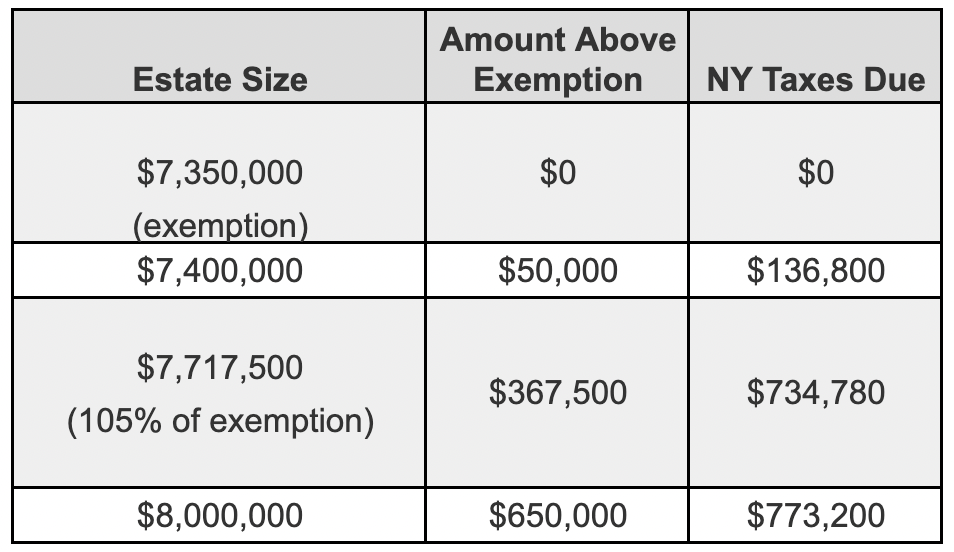
Estimated NY Estate Taxes Due
For instance, an estate valued at $7.0 million would not be subject to New York estate tax while an estate of $7.4 million would face a relatively modest tax of approximately $136,000. However, once the estate exceeds 105% of the exemption amount the entire estate becomes taxable. As a result, an estate valued at $8.0 million would owe a significantly higher tax of about $773,000.
Families Under the Exemption
Families currently below the New York estate tax exemption by a few million dollars, and those with strong future earnings potential, may find themselves subject to the estate tax sooner than expected.
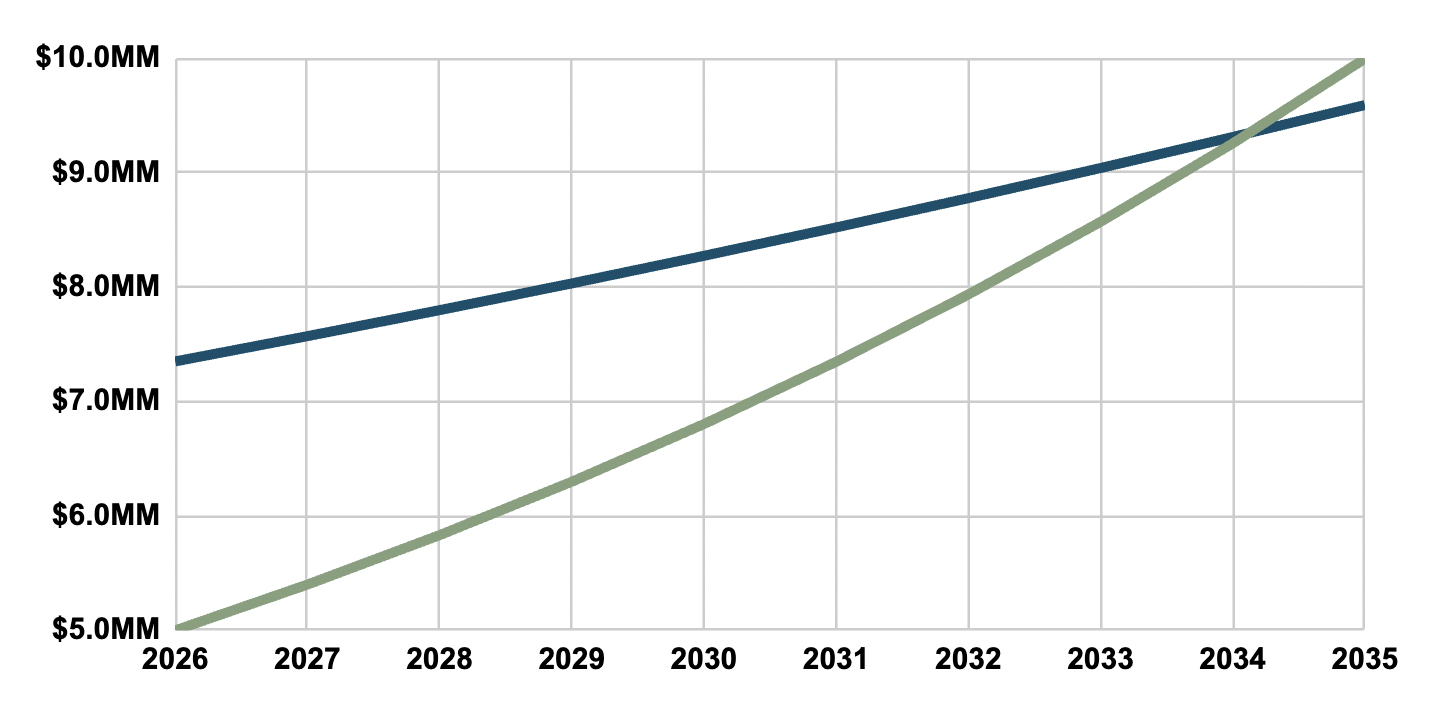
Estimated growth of the current NY estate exemption versus the projected growth of a $5MM taxable estate
For example, an individual’s taxable estate of $5 million would be $2.35 million below the 2026 exemption of $7.35 million. However, assuming the exemption grows by 3% annually (adjusted for inflation) and the estate earns an 8% annual return, it would reach the projected $9.3 million exemption level in about 8 years. Additional savings, large inheritances, or asset growth could accelerate that timeline. Given this potential risk, proactive estate tax planning is essential for families who may become subject to the New York estate tax in the future.
No Portability in New York
Unlike the federal estate tax exemption, which allows a surviving spouse to use any unused portion of their deceased spouse’s exemption (a feature known as “portability”), New York State does not offer this benefit. The federal election that allows the surviving spouse to use a deceased spouse unused estate exemption has no impact on the New York state estate tax. Without proper planning, this lack of portability can result in significant estate tax liability. For example, a New York couple with a combined estate of $10 million, split evenly between spouses, may end up paying NYS estate tax. If $5 million passes to the second spouse and the second spouse passes shortly thereafter with a $10 million estate, the resulting NY estate tax would be $1,067,600. It’s a common mistake for wealthy couples to move from a state without a state estate tax to New York without updating their estate documents. It may have been perfectly fine to leave all assets directly to the surviving spouse in a state without planning for an estate tax, but once in New York a couple near or above the New York estate tax exemption could run into issues.
Equalizing Estates to Minimize Estate Tax
Unlike the previous example, many couples do not have their assets evenly divided between them. If a couple with a $10 million net worth holds all assets in one spouse’s name and that spouse dies first, the estate could immediately face a New York estate tax bill of $1,067,600 if the first spouse did not take advantage of the marital deduction. To help mitigate this, couples should consider how their assets are allocated. It may make sense to divide the assets in equal shares or allocate an amount close to the exemption amount for the older spouse and the rest to the younger spouse. In some cases, it may make sense to transfer lower-basis assets to the older spouse or the one with the shorter life expectancy in order to take advantage of a potential step-up in basis to fair market value at death.
Credit Shelter Trusts
One strategy to avoid estate tax at the death of the second spouse is to leave assets to a “credit shelter trust” (also known as a “bypass trust”) upon the first spouse’s death. This type of trust can provide the surviving spouse with income and, if needed, principal distributions for health, education, maintenance, and support (HEMS). Using the earlier example, where each spouse holds $5 million, if the first $5 million is placed in a credit shelter trust at the first death, and the surviving spouse dies shortly thereafter, no New York estate tax would be due on the full $10 million estate.

Pros and Cons of Credit Shelter Trusts
Credit shelter trusts come with both advantages and trade-offs. On the plus side, they offer the surviving spouse added protection from creditors. However, the surviving spouse does not have unrestricted access to the trust assets, which may be a drawback for some families. Additionally, these trusts involve ongoing administrative responsibilities and costs. For example, the trustee must file an annual Form 1041 income tax return for the trust.
It’s also important to consider that assets held in a credit shelter trust do not receive a second step-up in basis at the death of the surviving spouse. As a result, the next generation may face higher capital gains taxes when those assets are eventually sold, potentially offsetting the estate tax savings. Families should weigh the benefits of reducing estate tax through a credit shelter trust against the potential loss of a second basis step-up and the associated capital gains implications for heirs. Families should also think through the appropriate balance of assets between spouses when it comes to credit shelter planning. The less monied spouse may not have enough of the overall assets in their name, so transfers and asset re-titling may be necessary.
In addition, families should be thoughtful about which assets are best suited for funding a credit shelter trust. Funding the trust with income-producing assets can provide ongoing support to the surviving spouse, while allowing assets expected to appreciate significantly to remain in the surviving spouse’s estate and benefit from a second step-up in basis. Alternatively, in cases where future estate tax exposure is a concern, it may make sense to place highly appreciating assets in the trust to prevent further growth within the surviving spouse’s taxable estate.
Old Credit Shelter Trusts
It’s important for families to periodically review and update their estate planning documents to reflect changes in tax laws and evolving planning strategies. For instance, prior to 2014, New York’s estate tax exemption per individual was just $1 million. Many older documents drafted during that time direct the full exemption amount to a credit shelter trust, which could now result in the trust being overfunded since the exemption is now much larger. Including language that gives the surviving spouse discretion to determine the amount allocated to the trust can provide greater flexibility and help avoid unintended tax consequences.
Disclaimer Trusts
Another strategy to reduce New York estate tax for a high-net-worth surviving spouse is the use of a “disclaimer trust.” Under this approach, estate documents can be drafted to allow all assets to pass to the surviving spouse using the unlimited marital deduction available to U.S. spouses. However, the surviving spouse may choose to “disclaim” a portion of the inheritance allowing those assets to instead pass into an irrevocable trust for the benefit of the couple’s children. It should be noted that the spouse must do so within nine months of the first spouse’s death.
To preserve the validity of the disclaimer, the surviving spouse must not take possession or control of the disclaimed assets. It is also essential to carefully assess the surviving spouse’s current and projected financial needs to ensure they retain sufficient resources. A strategy that saves on estate taxes but leaves the surviving spouse underfunded could lead to serious hardship. Like credit shelter trusts, disclaimer trusts do not receive a second step-up in basis at the second spouse’s death. Therefore, any potential estate tax savings should be weighed against the possibility of higher capital gains for the next generation.
Clayton Trust
An alternative to using disclaimer trusts for minimizing New York estate tax is a Clayton trust. This structure gives the executor the authority and flexibility to determine how much of the estate should be allocated to a credit shelter trust versus a qualified terminable interest property (QTIP) trust. Assets placed in the credit shelter trust are excluded from estate taxation at the death of both spouses, while the QTIP trust provides income access for the surviving spouse. By granting the executor discretion over the allocation, the burden of post-mortem estate tax planning is shifted away from the surviving spouse.
Santa Clauses for Estates Around the Cliff
For estates just above New York’s 105% estate tax cliff, charitable giving can be a highly effective strategy and can sometimes reduce the estate tax by more than the actual amount donated. As an example, a $7.6 million estate would be liable for an estate tax bill of $676,000, but a donation to charity of $250,000 reduces the tax bill to $0. A formula based clause in the estate documents could take effect during this type of situation. In many situations, families should be careful about the communication of an estate tax dependent formula based gift to avoid any misunderstandings. Of note is that while an estate gift to charity may reduce New York estate taxes, a lifetime gift can reduce future estate taxes and give a current income tax deduction subject to AGI limitations.
Gifting Strategies for Families above the Exemption
While strategies such as disclaimers, credit shelter trusts, Clayton Trusts, "Santa Clause" provisions, and asset equalization can be highly effective for families with estates in the $5 million to $14 million plus range, families with significantly higher net worth may need to adopt more aggressive lifetime gifting strategies to reduce their estates below the combined New York estate tax exemption thresholds. Families should take advantage of the annual gift tax exclusion, which is $19,000 per donor per recipient in 2026. For example, a couple with three married children and five grandchildren could gift up to $418,000 annually by giving the full exclusion amount to each family member. This strategy can meaningfully reduce the size of their taxable estate and help bring it below exemption thresholds.
We often recommend that families consider making smaller gifts during their lifetime rather than through their estate. Lifetime gifts not only allow recipients to benefit sooner, but they also avoid the possibility of revealing the full contents of the will. Additionally, families may want to accelerate gifting during market downturns or when asset values are temporarily depressed, as this can maximize the impact of both the annual gift exclusion and the lifetime exemption through strategic timing.
If the annual gift exclusion alone isn’t sufficient to meaningfully reduce a family’s taxable estate, a range of alternative gifting strategies may be appropriate, depending on the family’s goals, financial profile, and market conditions. One option is to make outright gifts using the lifetime federal estate and gift tax exemption, currently set at $15.0 million. Families should weigh the benefits of gifting versus the loss of a step-up in basis for those gifted assets at death.
Using Gifting to Trusts to Reduce New York Estate Taxes
Families might want to consider gifting through trust structures. Trusts can offer many benefits including protection against potential creditors, protection against a potential divorce for the beneficiary, professional management and administration, but trusts can come with potential increased complexity and cost. Given trusts’ ability to allocate lifetime generation skipping tax exemption ($15 million in 2026), trusts can not only facilitate Federal and New York estate tax reduction for the grantor of the trust assets, but can reduce estate taxes for future generations as well.
Common strategies using trusts used to minimize estate taxes can include gifts to grantor irrevocable trusts for the next generation and beyond. The frequently used “grantor trust” feature allows the trust grantor to continue to pay the income taxes on the trust, which allows the trust assets to grow faster while simultaneously decreasing the grantor’s estate size for future estate tax savings. Spousal Lifetime Access Trusts (SLATs) allow gifts to be made to a trust that gives the grantor indirect access through their spouse, which is a beneficiary of the trust. Another impactful strategy are gifts to a resident exempt trust, which allows trust income to accumulate in a trust without incurring New York state income taxes.
Charitable Giving for Estate Tax Reduction
Families with modest charitable needs might consider a donor advised fund (DAF), while families with large ongoing charitable giving goals might explore a charitable lead trust (CLT) to reduce their taxable estate. Moreover, families that wish to make significant charitable gifts in the future, while also retaining income in the meantime, may benefit from a charitable remainder trust (CRT). Although New York State does not impose a gift tax, gifts exceeding the annual exclusion amount must be reported on IRS Form 709, which also initiates the IRS statute of limitations. These charitable structures can also be initiated at death to reduce the overall size of the estate.
New York’s Three Year Gift Add Back Rule
Taxable gifts made within three years of death are added back to the gross estate for the New York estate tax calculation. This provision is currently in effect until January 1, 2032. Consequently, exceptions to the three year rule including annual exclusion gifts, charitable gifts, and direct payments of tuition and medical expenses can be very effective estate reduction strategies for New York residents that are over the the estate tax exemption and in poor health. Families might want to consider staging taxable gifts over time to diversify the risk of three year add back gifts through a series of gifts over time. Families should consider that oftentimes late in life gifts and significant estate plan changes are frequently challenged by unhappy family members. Of note is that gifts of out of state real estate or tangible assets are not subject to the three year add back rule, which reflects that they are not part of the New York taxable estate to begin with.
Also, it may seem obvious, but it’s important to project the financial impact of gifting on one’s financial position. Optimizing for post-death estate tax minimization, while also impairing the financial resources necessary to live a comfortable retirement can be disastrous.
Market Conditions and Gifting Strategies
It should be noted that interest rates often play a key role in determining which gifting strategies are most effective. In a high interest rate environment, structures like charitable remainder trusts (CRTs) and qualified personal residence trusts (QPRTs) tend to be more advantageous. Conversely, low interest rate environments generally favor strategies such as grantor retained annuity trusts (GRATs) and intentionally defective grantor trusts (IDGTs). In either case, wealthy families are often best served by implementing these strategies proactively, particularly in New York, where gifts made within three years of death may be pulled back into the estate under the state’s claw back rule.
It’s also important to consider the individual circumstances and tax profiles of the recipients when deciding which assets to transfer. For instance, it is typically more tax-efficient for a lower-income beneficiary to receive income-generating assets or those with large unrealized capital gains, while high-income recipients may benefit more from receiving tax-exempt assets like municipal bonds.

Gifting strategies for families above the NY estate exemption
Relocating to Avoid the Estate Tax
Potentially the most impacful way to avoid New York estate tax is to establish residency in a state that does not impose one, such as Florida or Texas. However, successfully changing residency requires careful planning and coordination with a CPA and a financial advisor as the burden of proving a change in domicile rests with the taxpayer, not New York State. Simply spending fewer days in New York, using tracking apps like Monaeo, or obtaining a Florida driver’s license is probably not sufficient.
A comprehensive strategy should be developed to ensure the individual satisfies both the statutory residency and multi-factor domicile tests required to demonstrate a legitimate change in residency. The burden of proof for a change of domicile in New York is on the tax payor. Factors that can make a change of residence/domicile argument weaker include continuing to run a business from New York, keeping important near and dear possessions in New York, maintaining memberships at social clubs in New York, spending important holidays or family events in New York, and/or having a larger home in New York relative to the home in the new state. Families should work with their advisors to maintain documents, log books, and written descriptions of the move in case of a post-death estate residency audit. Even factors like revising your estate documents in the new state and having probate conducted in the new state can be impactful in building the residency file.
Planning for Nonresidents with New York Assets
Special planning should be considered for New York nonresidents with New York assets, since these nonresidents can potentially face a large New York estate tax bill. Both New York assets and non New York assets factor into the estate tax calculation. The calculation first looks at the estate’s total gross estate, calculates the non-resident’s estate tax bill as if he or she were a New York resident, and then multiplies that tax by the ratio of New York assets to total estate. For example, a Florida resident with $10 million of total assets including a $1 million vacation home in New York would be liable for 10% of the state estate liability due on a New York $10 million estate, or approximately $106,700.
Nonresidents have a variety of options to reduce potential New York estate tax liability. Nonresidents with large art or jewelry collections should consider maintaining them outside of New York. Selling, downsizing, or renting out New York property is another strategy. The estate tax benefits of selling should be considered over the potential holding benefits of getting a step-up in basis at death. Given that the New York nonresident estate tax calculation includes one’s overall estate, reductions in the overall estate through gifting or otherwise also reduce potential New York estate tax liability.
Another option for real estate would be to consider transferring New York real estate to an LLC or other entity to convert tangible real estate property to intangible property. Intangible property for a nonresident likely wouldn’t be considered New York property. Property owners should tread carefully with this strategy since transferring real estate to an entity could be problematic for insurance, may need the lender’s or building’s consent, could trigger New York or New York City property taxes, or reduce property tax benefits.
Often, nonresidents will spend significant time back in New York receiving medical care prior to passing. While this may not be a deciding factor later in determining estate residency, families should consider that auditors may look at the time spent back in New York as a residency factor.
New York Estate Tax and Business Owners
Business owners and founders face a range of unique issues related to the New York estate tax. A significant estate tax liability for a business owner’s estate can create liquidity problems for both the family and the business, potentially forcing the sale of assets or disrupting operations.To mitigate this risk, owners should establish a comprehensive continuity plan to preserve the business’s value in the event of their passing. A well-rounded strategy should include a clear succession/exit plan and continuity plan, a properly structured and adequately funded buy-sell agreement (especially for those with partners), and, where appropriate, key person insurance to provide immediate liquidity and financial stability.
New York Elective Share Planning
In New York, the surviving spouse can elect to receive the greater of $50,000 or 1/3 of the deceased spouse’s estate. This election can unravel prior estate planning. For example, beneficiary designations or revocable trusts don’t avoid a surviving spouse’s elective share. Also, if a surviving is set to receive an income benefit or discretionary interest in a trust, they can gain a greater proportion of the assets by electing those assets. In terms of planning, a spouse’s elective share can be waived before or during a marriage, and lifetime gifts to irrevocable trusts can also be used reduce the elective share base. Of note is that when a client that moves from New York to another state, they are then subject to the elective share rules of that state.
Other New York Cliff Strategies
Since administrative expenses, such as accounting or legal fees, are deductible on either the estate tax return or estate’s income tax return, it may make sense to optimize which return to put these expenses on. Another issue to focus on is valuation of illiquid assets. An appraisal later revised under audit later can have a big estate tax financial impact, so advisors should pay close attention to the quality of estate property valuations. Since IRA assets can potentially be subject to both estate tax and future income tax to the beneficiary, it may makes sense to consider Roth conversions. Paying the taxes on conversions can simultaneously shrink the taxable estate and reduce the income tax burden on the next generation. Families should also be mindful that New York does not tax distributions on IRAs up to $20,000 annually for those over 59.5.
New York State Tax Liquidity
For estates without enough liquidity to pay the taxes payable, it is possible to get an extension for undue hardship for up to four years. Families with large illiquid asset positions should consider the impact of converting them to liquid assets to cover a future estate tax liability. Irrevocable life insurance trusts (ILITs) can be one option to consider as they can potentially provide a source of post-death liquidity through loans to the estate or post-death purchases of illiquid assets.
Avoiding Common Estate Issues
New Yorkers should also be aware of potential non-estate tax pitfalls in their estate planning that can lead to costly disputes or unintended consequences. Common issues include appointing fiduciaries who are unfit or unqualified for the role, naming out-of-state fiduciaries without addressing related legal or tax complications, and using vague or ambiguous language in wills. Placing children who don’t get along into co-fiduciary roles can create unnecessary conflict, as can disinheriting family members without taking appropriate legal precautions. Other often-overlooked risks include failing to update documents to account for children born after the estate plan was executed or marriages that occur shortly before death as both of which can become flashpoints for litigation.
While federal estate taxes won’t impact most New Yorkers, New York State’s estate tax presents a significant concern for high-net-worth and mass affluent families. Fortunately, with proactive and well-structured planning, there are effective strategies available to minimize tax exposure and preserve wealth for future generations.
David Flores Wilson, CFP®, CFA, CM&AA, CEPA is a New York City-based CERTIFIED FINANCIAL PLANNER™ Practitioner & Managing Partner at Sincerus Advisory. Click here to schedule a time to speak with us.
The information provided through this communication is intended solely for the general knowledge of visitors and does not constitute an offer or a solicitation of an offer for the purchase or sale of any security.